Gracie Abrams’ “That’s So True” entered the Hot 100 top 10 the week of 11/23/24, marking her first appearance in the region. The song’s widespread success is driven by its super-infectious chorus, which is cleverly crafted to maximize catchiness, memorability, engagement, and emotional resonance.
This analysis focuses on choruses 2 and 3, which are each comprised of two three-line stanzas. In contrast, chorus 1 consists of a single three-line stanza.
Melodic Qualities
Like many pop hits, the chorus adheres to key components of the Hit Songs Deconstructed K.I.S.S. ME principle (Keep it Simple, Singable, and Memorable), allowing listeners to easily connect with and recall the song’s primary “hook center.” Its key K.I.S.S. ME traits include abundant stepwise motion, small intervallic leaps, mainly short melodic phrases, and logical, easy-to-follow melodic patterns.
However, the chorus also diverges from the K.I.S.S. ME principle in significant ways. They include its wide range, varied rhythms, and occasional pronounced leaps. While these deviations make the chorus slightly harder for listeners to sing along with, they serve several key purposes: setting it apart from other sections, sustaining interest, amplifying emotional impact, and showcasing Abrams’ vocal prowess.
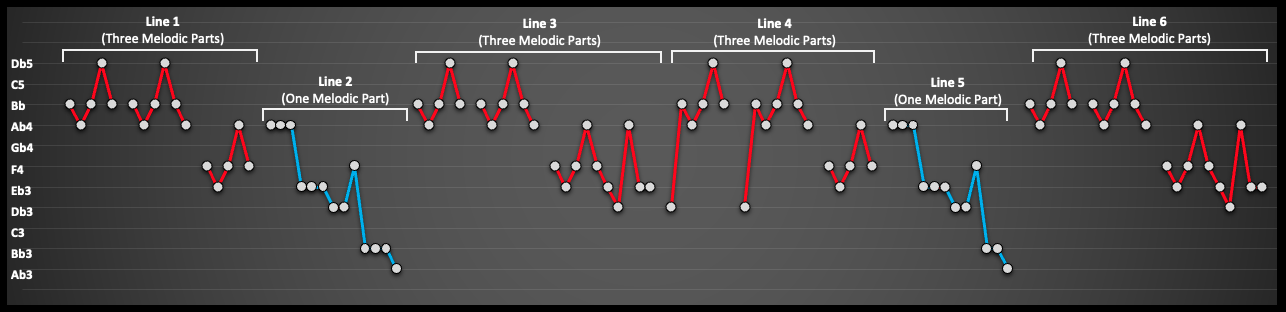
“That’s So True’s” Chorus Melodic Patterns (Choruses 2 & 3)
Melodic Structure
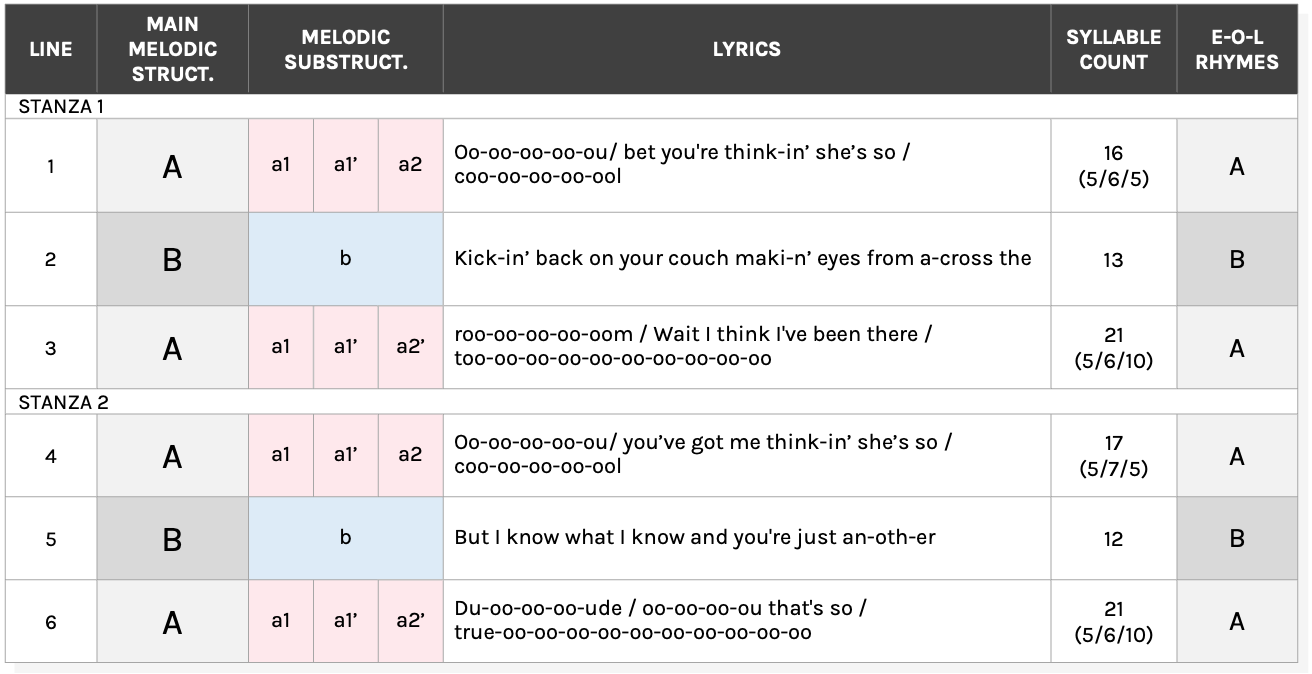
The chorus’s main melodic structure alternates in an ABA / ABA format across its two stanzas, achieving an effective balance of repetition and contrast. The A-melodies deliver and reinforce the song’s main vocal hooks, receiving the most time within the section. Meanwhile, the B-melodies provide engaging contrast, highlight lyrical developments, and set up the A-melody hooks for maximum impact.
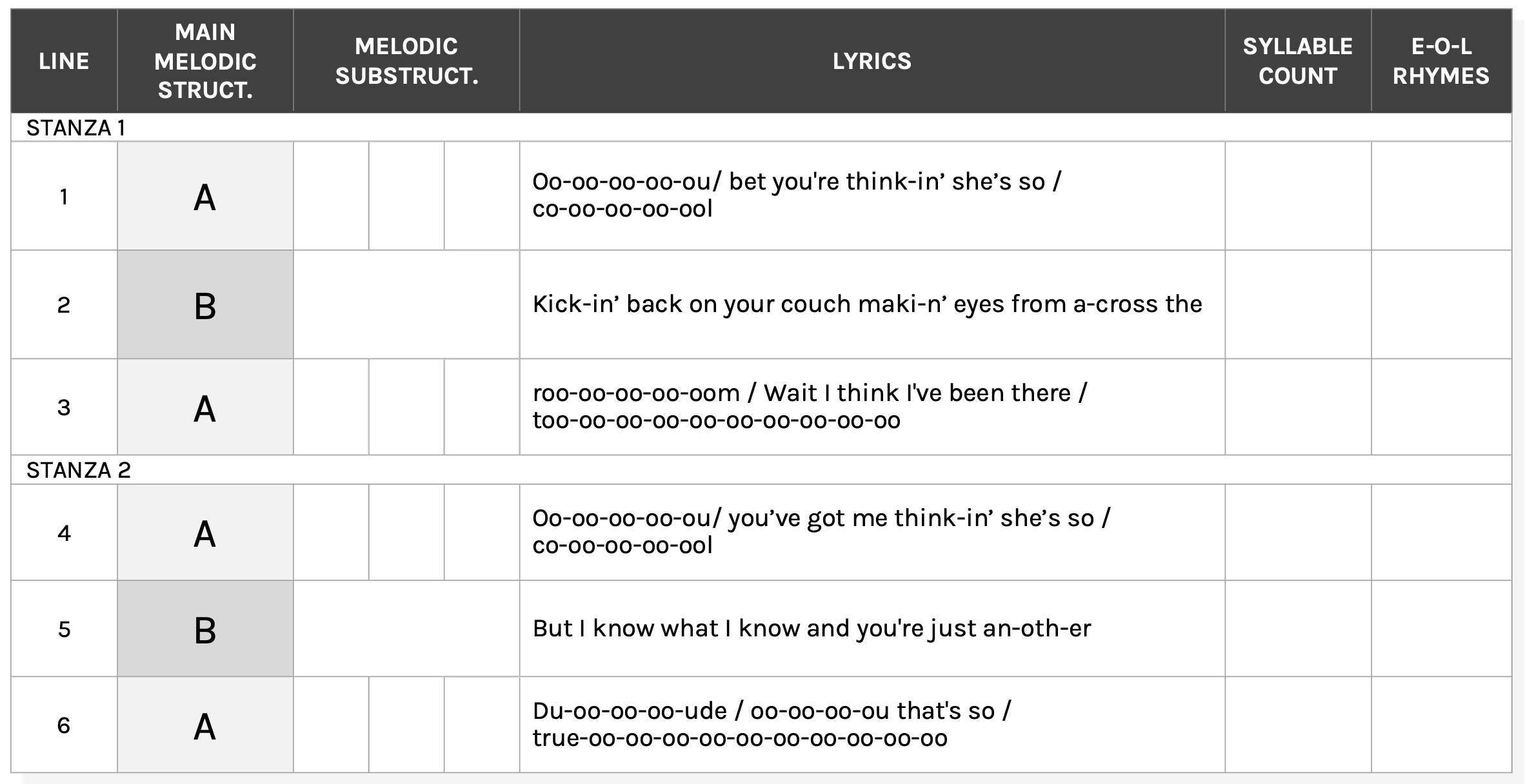
A closer look at the melodic substructure reveals the chorus’s intricate craftsmanship:
Line 1
The first line comprises three similar but distinct melodic subparts: a1 – a1’ – a2, each subtly segmented by prolonged notes at the end of their phrases. This segmentation is effective on two key levels: breaking the lengthy 16-syllable line into shorter, easier-to-digest and remember segments and letting each hook melody to stand out and shine.
- Subpart a1 (“Oo-oo-oo-oo-ou”): This vibrant Alternating Melodic Pattern (A.M.P.) melody is “dressed up” with nonsensical syllables, forming the song’s primary vocal hook and motif.
- Subpart a1’ (“Bet you’re think-in’ she’s”): Nearly identical to a1, it includes an additional prolonged note at the end to accommodate the lyric and provide additional segmentation against the subpart a2 melody that follows.
- Subpart a2 (“coo-oo-oo-oo-ool”): Similar to a1, this subpart shifts to a lower range, reinforcing the hook and drawing attention to the lyric while leading the listener into the descending melody in line 2.
Line 2
Line 2 is composed of subpart-b. It begins a step above from where line 1 ends and descends a full octave from Ab4 to Ab3. The descent alternates between leaping and stepwise motions, with a notable upward embellishing leap on the lyric “eyes.”
While its wide descending range, 13-syllable length, and fast-moving, direct rhythms make the line a bit more difficult for the average listener to sing along to, its descending “platform” progression bolsters coherence. Each of its four platforms features repetitive, stagnant notes starting on Ab4, Eb3, Db3, and Bb3, respectively. This progression, along with each platform’s conclusion on a more sustained note (e.g., sixteenth – sixteenth - eighth), breaks the line into shorter, easier-to-digest three-syllable segments: “Kick-in’ back / on your couch / mak-in’ eyes / from a-cross.”
Additionally, the line features a clever relationship between the melody and lyrics. Instead of concluding on the lyric “room” and resolving the lyrical statement, the line lyrically and melodically concludes on the lyric “the.” This creates tension and anticipation for line 3 that follows while setting up the next “oou”-sounding hook to stand out and connect.
Line 3
Line 3 resolves line 2’s lyrical tension while introducing the familiar a1 melody with a pronounced leap on “roo-oo-oo-oo-oom.” The line is highly similar to line 1 except for an extra five syllables at the end of the subpart a2’ melody on the stretched lyric “too.” This variation provides the hook with an engaging melismatic quality while bringing the first stanza to a conclusion.
Lines 4 – 6
The second stanza mirrors the first in melody, with minor adjustments to accommodate the lyrics. For example, line 4 adds one note, while line 5 removes one. The clever interplay between melody and lyrics also continues. The “oou”-sounding hook is reinforced in key lyrics (“oou,” “cool,” “dude,” and “true”), and line 5’s lyrical incompleteness sets up the hook’s leaping re-entry in line 6.
Additional Chorus Accentuators
Beyond its catchy and clever melodies and lyrics, several techniques are used to further heighten the chorus’s impact:
- Transitional S.I.A.s: Choruses 1 and 2 are each preceded by a full accompaniment pull S.I.A. (Section Impact Accentuator) at the end of the pre-chorus. This technique provides a brief transitional lull that heightens listener engagement and magnifies the impact of the dense and energetic chorus that follows.
- Melodic and Rhyme Scheme Mirroring: The chorus’s ABA melodic structure mirrors its end-of-line rhyme scheme, enhancing cohesion. The unresolved lyrics in lines 2 and 5 (“the” and “an-oth-ER”) cleverly form the B-rhyme (note that Abrams pronounces “ER” more like “UH” to make a connection with “the”).
- Emotional Delivery: Abrams’ subtle vocal techniques, such as dragging her delivery on the a1’ melodies and including breaths between phrases, intensify the emotional connection.
Key Takeaways for Songwriters & Producers
- Hook Reinforcement Through Repetition and Variation: Repeat the core hook melody and rhyme to ingrain it in listeners' minds, but introduce subtle variations (e.g., range shifts, additional notes, or lyrical developments) to maintain interest and freshness.
- Craft Strategic Tension and Release: Employ unresolved lyrical and melodic phrasing to build anticipation, seamlessly transitioning into memorable and impactful hook moments.
- Enhance Emotional Resonance: Leverage vocal delivery techniques (e.g., stretched notes, subtle pauses, breath sounds) to deepen emotional impact and listener connection.
Song Section Clips
Chorus 1 (0:21 - 0:50)
Chorus 2 (1:05 - 1:50)
Chorus 3 (1:58 - 2:46)